
Bytecly journal
RAG Explained: Connect AI to Your Business Data
Learn how Retrieval-Augmented Generation (RAG) connects AI and LLMs to business data, including vector databases, embeddings, security, and real-world use cases.
- Artificial Intelligence
- RAG
- LLMs
- AI Engineering
- Vector Databases
- Enterprise AI
- Software Architecture
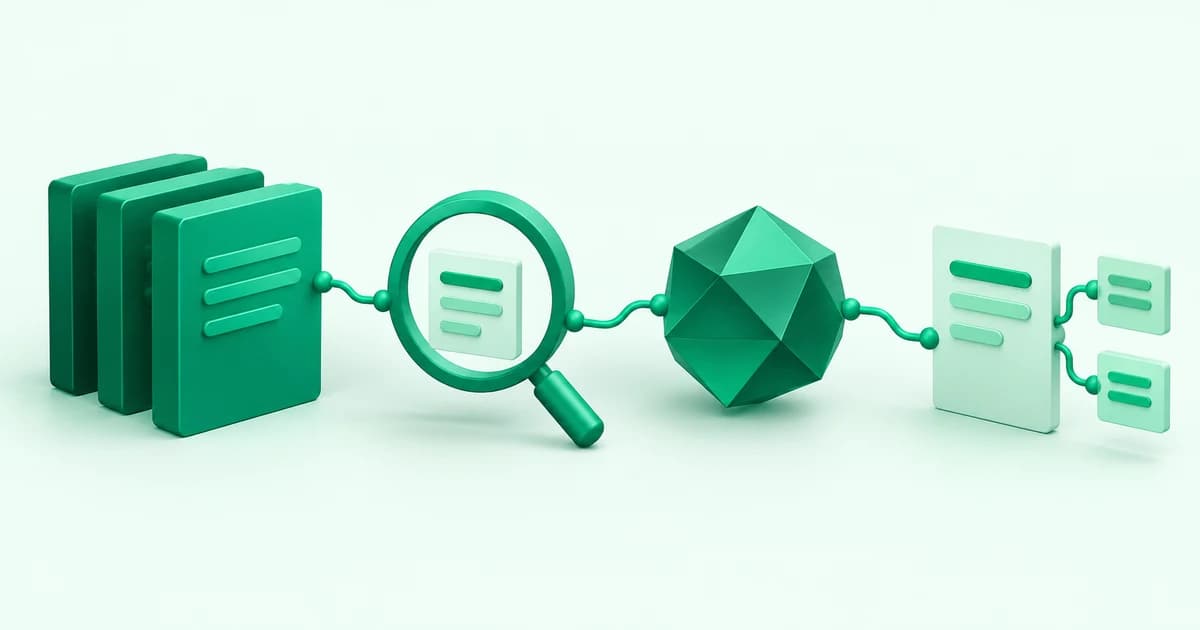
Large Language Models (LLMs) have transformed how people interact with software. They can answer questions, summarize information, generate content, and assist with increasingly complex tasks.
But there's an important limitation: an AI model doesn't automatically know anything about your business.
It doesn't inherently understand your internal documentation, customer records, operational processes, or the latest information stored in your applications.
This creates a fundamental challenge for businesses adopting AI.
How can you make an AI system answer questions using your company's actual information without constantly retraining the model?
One of the most practical solutions is Retrieval-Augmented Generation (RAG).
RAG enables AI applications to retrieve relevant information from external knowledge sources and use it to generate more informed, contextually relevant responses.
It's one of the foundational architectural patterns behind modern enterprise AI applications.
This is article 03 in Bytecly's AI Engineering Series. Start with Beyond Chatbots for the wider software context, or read AI Agents vs. Traditional Automation to explore how applications choose and execute actions.
What Is Retrieval-Augmented Generation?
Retrieval-Augmented Generation is a technique that combines information retrieval with the natural language capabilities of a Large Language Model.
Instead of relying exclusively on knowledge learned during training, a RAG system retrieves relevant information from an external source when a user submits a request.
That information is then provided to the LLM as additional context. Microsoft's RAG overview describes how retrieval can ground responses in an organization's own content.
The model uses the retrieved material to generate its response.
Consider a simple example.
Hypothetical example: an employee asks, "What is our company's refund policy for annual subscriptions?"
Without access to company documentation, a general-purpose LLM may not know the answer.
With RAG, the application can search the organization's internal knowledge base, retrieve the relevant policy, and provide it to the model.
The AI can then explain the policy in natural language and reference the supporting document.
RAG transforms a general-purpose language model into an assistant that can work with organization-specific knowledge.
However, the quality of its answers still depends on the accuracy of the retrieved information and the reliability of the overall system.
How RAG Works
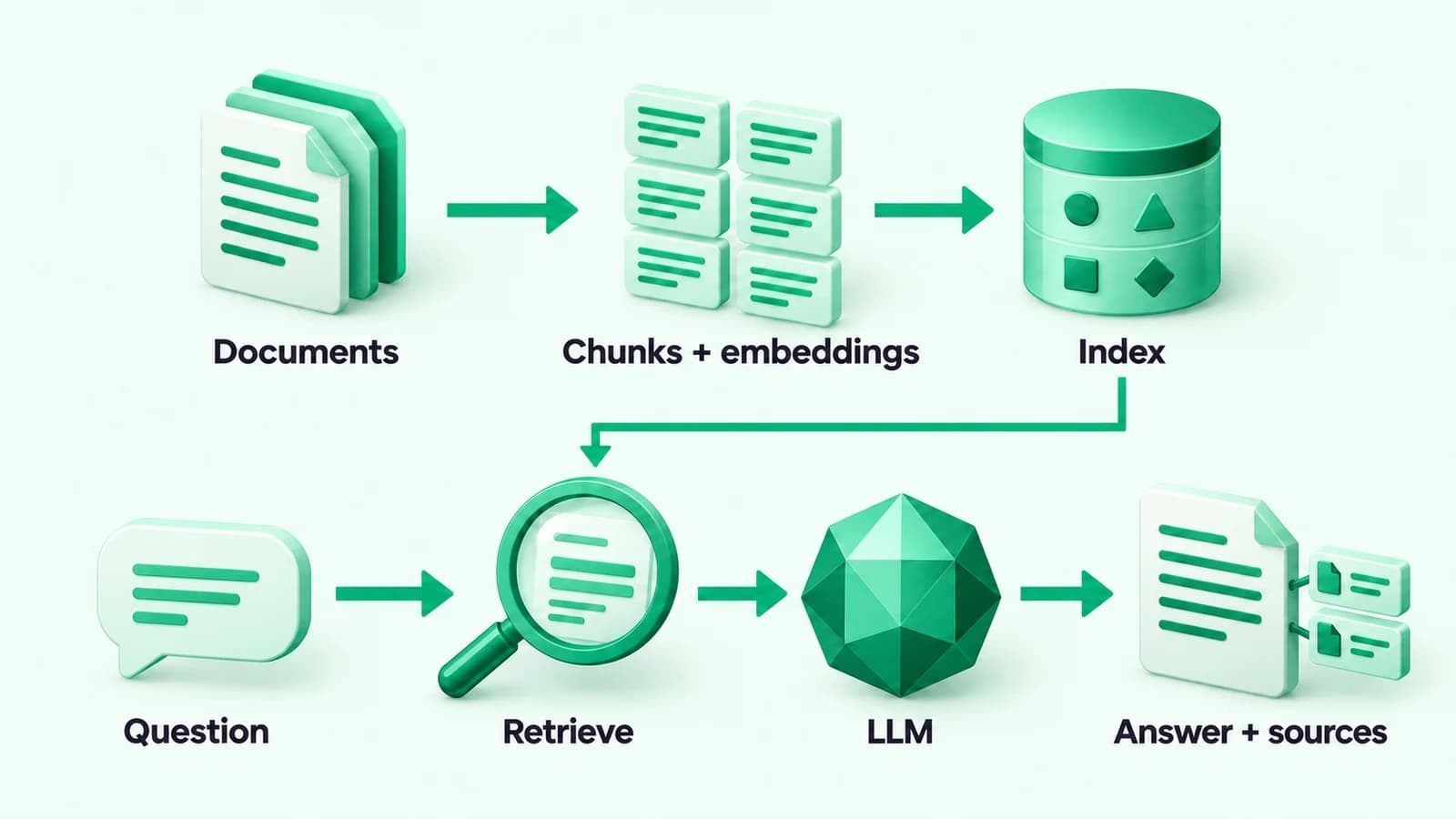
A typical RAG architecture consists of two major processes: preparing information for retrieval and retrieving that information when a user asks a question.
Step 1: Collect and prepare business data
The system begins by collecting information from authorized sources.
These might include:
- Internal documentation and knowledge bases.
- Product manuals and technical specifications.
- Company policies and procedures.
- Customer support articles.
- Contracts and operational documents.
- CRM or business application records.
Before indexing, documents are typically cleaned, normalized, and divided into smaller sections called chunks.
Each chunk may include metadata such as its source, document title, modification date, and access permissions.
This preparation helps the retrieval system locate relevant information efficiently.
Step 2: Generate embeddings
Many RAG systems use embeddings to represent text as numerical vectors.
An embedding model converts a piece of text into a mathematical representation that captures aspects of its semantic meaning.
Texts with similar meanings often produce vectors that are close together in the embedding space.
For example, a question about subscription cancellation might be semantically related to documentation describing account termination, even if the exact words differ.
Embeddings make it possible to search information based on meaning rather than relying entirely on keyword matching.
Step 3: Store information in a searchable index
The generated embeddings are stored in a vector-capable database or search index.
Depending on the architecture, this might be a dedicated vector database or an existing database with vector search capabilities.
PostgreSQL with the pgvector extension is one example.
Organizations can also combine vector search with traditional full-text search to improve retrieval accuracy.
This approach is commonly known as hybrid search.
Step 4: Retrieve relevant information
When a user submits a question, the application searches the indexed information.
A retrieval pipeline may use semantic similarity, keyword matching, metadata filters, or a combination of techniques.
The goal is to identify the most relevant information for the user's request.
More advanced systems may use a reranking model to evaluate candidate results and prioritize the strongest matches.
Step 5: Generate a grounded response
The application sends the user's question and selected retrieved information to the LLM.
The model generates an answer using that context.
A well-designed system can also provide citations, allowing users to inspect the documents supporting the response.
If the available information is insufficient, the assistant should acknowledge that limitation rather than invent an answer.
The objective isn't simply to generate a convincing response. It's to generate a useful response supported by verifiable information.
RAG vs. Fine-Tuning: What's the Difference?
A common question is whether businesses should use RAG or fine-tune an existing model.
These techniques solve different problems.
RAG provides external information to a model at inference time.
Fine-tuning changes a model's behavior by training it further on selected examples.
- Purpose: RAG supplies external knowledge; fine-tuning adapts model behavior through training.
- Updates: RAG can use a refreshed knowledge index. Changing information learned through fine-tuning may require further training.
- References: RAG can return source citations. Fine-tuning alone does not provide document references.
- Business data: RAG retrieves material when authorized. Fine-tuning may incorporate selected business examples into training; either approach needs appropriate data controls.
- Infrastructure: RAG needs a retrieval and indexing pipeline. Fine-tuning needs training and model management.
- Best fit: RAG suits knowledge-intensive applications; fine-tuning can suit specialized behavior and output patterns.
For example, a customer support assistant that needs access to frequently updated product documentation is a strong candidate for RAG.
An application requiring highly specialized output formatting or task-specific behavior might benefit from fine-tuning.
Some advanced systems combine both approaches.
However, businesses should generally evaluate simpler retrieval and prompting techniques before investing in model customization.
Real-World Business Applications of RAG
RAG is useful wherever organizations need AI to work with information that is private, frequently updated, or too specialized to rely on a general-purpose model.
1. Internal company knowledge assistants
Employees often spend significant time searching through documents, shared folders, and internal knowledge bases.
A RAG-powered assistant can provide a conversational interface to approved company information.
Instead of manually searching multiple sources, an employee could ask:
"Where can I find our onboarding process for new customers?"
The assistant could retrieve the relevant documents, summarize the process, and provide references.
This can reduce information discovery time and make institutional knowledge easier to access.
2. Intelligent customer support
Customer support systems frequently rely on extensive product documentation, troubleshooting guides, and policy information.
RAG can help an AI assistant retrieve accurate product information before generating a response.
For example, a SaaS customer might ask how a particular integration works.
The assistant could retrieve the relevant technical documentation and explain the setup process.
When appropriate, the system could escalate uncertain or sensitive requests to a human support representative.
3. AI-powered SaaS applications
RAG can make SaaS products more context-aware.
Imagine a business management application containing operational reports, configuration guides, and internal documentation.
Users could ask questions about their business processes or application features without navigating multiple dashboards.
For example:
"Explain how our reservation cancellation policy works."
The application could retrieve the relevant policy and generate an understandable explanation.
For live operational metrics, however, structured database queries or analytics APIs may be more appropriate than document retrieval.
An effective AI application can combine both approaches.
4. Technical documentation assistants
Software engineering teams maintain extensive documentation covering APIs, architecture, infrastructure, and development practices.
RAG-powered developer assistants can help teams locate relevant technical information.
A developer might ask:
"Which service handles customer authentication, and how does it communicate with the API?"
The assistant could retrieve architecture documentation and explain the relevant components.
This is especially useful in complex applications with multiple services and repositories.
5. Document analysis and research
Organizations regularly process large collections of contracts, reports, proposals, and other documents.
RAG can help users locate relevant sections and compare information across multiple sources.
For example, a business analyst could ask:
"Which supplier agreements include automatic renewal clauses?"
The system could retrieve matching sections and identify the relevant documents for review.
For legal, financial, or other consequential decisions, human verification remains essential.
Why RAG Is More Than a Vector Database
One of the most common architectural mistakes is assuming that adding a vector database automatically creates a reliable RAG system.
Vector search is only one component.
A production-ready retrieval system requires careful attention to several additional areas.
Document quality and chunking
Poorly structured documents can lead to irrelevant or incomplete retrieval results.
Chunk size, document boundaries, headings, and metadata all influence retrieval quality.
A system that splits information without considering its structure may separate important context from the text it explains.
Hybrid retrieval and reranking
Semantic similarity is useful, but it doesn't always identify the best results.
Exact identifiers, product names, error codes, and technical terms may benefit from keyword search.
Hybrid retrieval combines different search strategies, while reranking can improve the relevance of selected results.
Access control and tenant isolation
Business information is often sensitive.
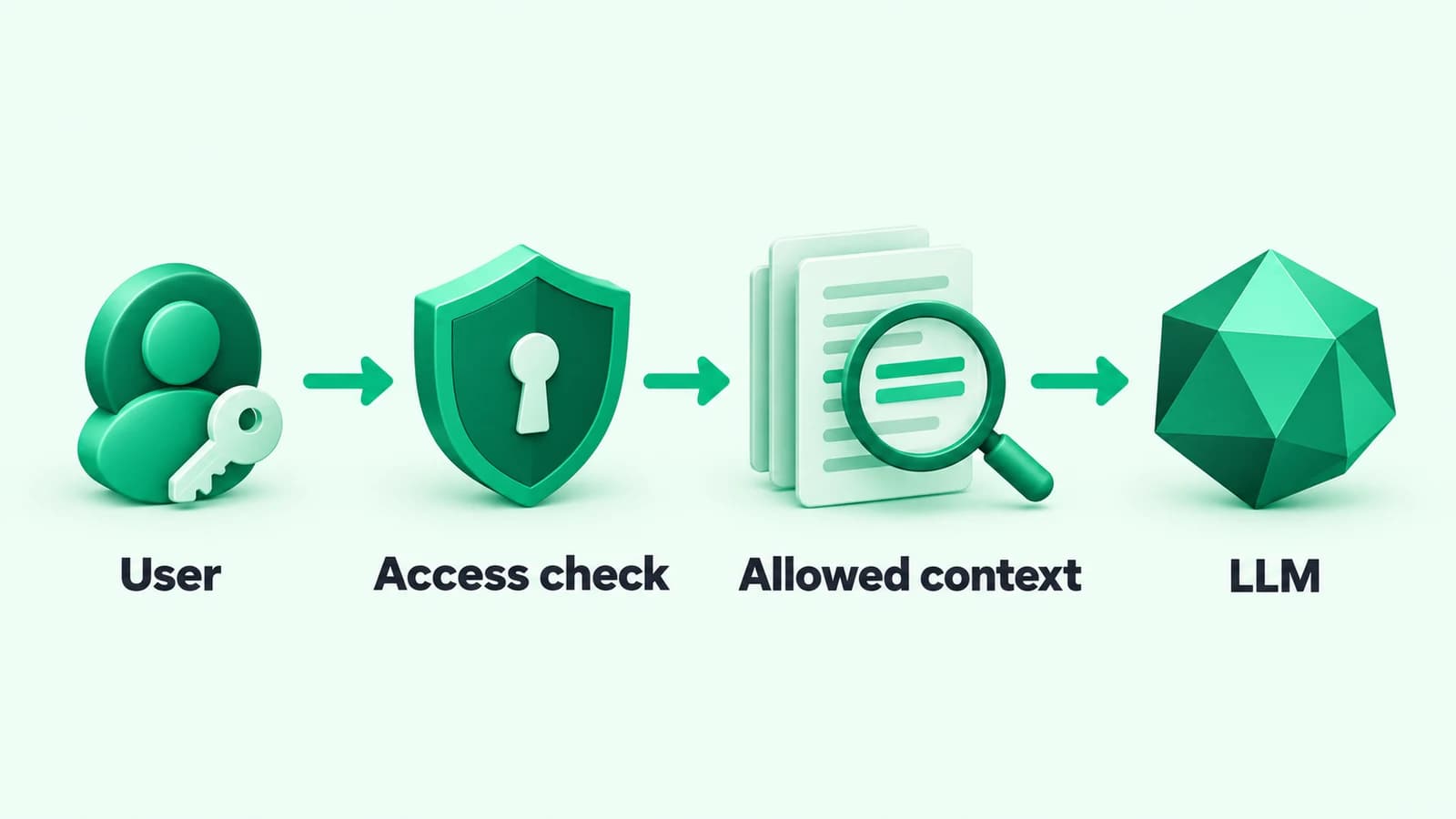
A multi-tenant SaaS application must ensure that users can only retrieve information they are authorized to access.
Access permissions should be enforced by trusted application logic before information reaches the model. Derive tenant and document permissions from the authenticated session, and check them during retrieval rather than accepting a tenant identifier supplied by the model.
An instruction telling the LLM not to reveal private data is not a substitute for authorization.
Freshness and synchronization
Business documents change.
A reliable RAG system needs mechanisms for detecting updates, refreshing indexes, and removing deleted or outdated information.
Otherwise, the assistant may continue referencing obsolete policies or documentation.
Evaluation and monitoring
Retrieval quality should be measured rather than assumed.
Useful metrics include retrieval relevance, answer correctness, citation accuracy, latency, and operational costs.
Evaluation datasets can help developers detect regressions when changing embedding models, chunking strategies, or retrieval algorithms.
These considerations determine whether a RAG prototype can evolve into dependable production software.
RAG Security: Protecting Business Information
Connecting AI to internal knowledge introduces important security responsibilities.
A RAG system may process confidential documents, customer information, or commercially sensitive records.
Organizations should implement safeguards such as:
- Authentication and role-based access control.
- Tenant-level data isolation.
- Encryption and secure credential management.
- Retrieval filters based on verified permissions.
- Appropriate retention and deletion policies.
- Monitoring and auditing of sensitive operations.
- Protection against prompt injection in retrieved documents.
Prompt injection deserves particular attention.
A malicious document might contain instructions intended to manipulate the assistant.
Because retrieved documents are external information, their contents should be treated as untrusted data. They must not gain the authority of system instructions.
The application must maintain clear boundaries between user requests, retrieved information, and privileged operations. OWASP's prompt injection guidance describes indirect injection through external content and explains why RAG does not eliminate this risk.
Review provider data handling and decide what may enter prompts, logs and caches. Apply tenant and access boundaries to those stores too, including when permissions change or documents are deleted.
A Practical RAG Architecture
A modern RAG application can be implemented using a modular architecture.
For example, a TypeScript-based SaaS platform might use:
Application layer: A web application that accepts user requests and displays responses.
API layer: A backend responsible for authentication, authorization, document management, and AI orchestration.
Database: PostgreSQL for application records, document metadata, and potentially vector storage through pgvector.
Storage: Object storage for original documents and uploaded files.
AI services: Embedding models for semantic indexing and LLMs for response generation.
Background processing: Asynchronous jobs for document ingestion, chunking, embedding generation, and index synchronization.
Observability: Monitoring for retrieval performance, model usage, failures, and operational costs.
A typical request follows this sequence:
- The user submits a question.
- The backend authenticates the request and determines the user's permissions.
- The retrieval system searches authorized knowledge sources.
- Relevant results are filtered, ranked, and prepared as context.
- The LLM generates a response using the retrieved information.
- The application checks the output and source references, then returns the answer or an appropriate fallback. These checks reduce risk; they cannot guarantee that every generated claim is correct.
The specific technologies may vary, but the architectural principles remain consistent.
When RAG Is Not the Right Solution
Although RAG is powerful, it shouldn't be used for every AI feature.
A simple application that generates marketing copy may not need external knowledge retrieval.
A system that calculates invoice totals should use deterministic business logic.
A dashboard showing live revenue metrics should generally query its authoritative data source directly.
And a workflow that executes business operations may require structured tool calling rather than document retrieval.
In many cases, the best architecture combines RAG with conventional APIs, database queries, machine learning models, and controlled AI tools.
The important question is not whether an application uses RAG.
It's whether retrieval meaningfully improves the application's accuracy, relevance, and usefulness.
Building Knowledge-Aware AI at Bytecly
At Bytecly, we see RAG as an important building block for intelligent software.
Modern businesses already possess valuable information across their applications, documents, databases, and internal systems.
The challenge is making that information accessible in ways that are useful, secure, and efficient.
Our approach to AI-powered software focuses on combining reliable application architecture with practical intelligence.
That includes designing secure data integrations, scalable APIs, retrieval pipelines, and AI-powered user experiences around real business requirements.
We believe the strongest AI applications don't simply generate answers.
They connect users with the right information, explain it clearly, and support better decisions.
Final Thoughts: AI Becomes More Valuable With the Right Context
Large Language Models provide powerful language capabilities, but they don't automatically understand an organization's unique knowledge.
Retrieval-Augmented Generation helps bridge that gap.
By connecting AI applications to relevant external information, businesses can create assistants that are more useful, context-aware, and grounded in their own data.
However, effective RAG requires much more than embedding documents into a vector database.
It requires thoughtful data preparation, reliable retrieval, strong access controls, continuous evaluation, and careful software engineering.
The real value of enterprise AI isn't just what a model knows. It's how effectively your software connects intelligence with the information your business actually needs.
Turn Your Business Knowledge Into Intelligent Software
Your business already generates valuable information. The next step is making that information easier to access and use.
At Bytecly, we design and develop modern software, SaaS platforms, and AI-powered applications that connect technology with real business needs.
Let's build software that puts your knowledge to work.
Explore our AI solutions, SaaS development and custom software services, or see how our process starts with discovery.
Arrange a discovery call and tell us which knowledge sources and business tasks you want to connect.
See our Privacy Notice for how we handle what you send us.